Half-Smokes, Mumbo Sauce and the Public Market
A city's food is easiest to read where it is cheapest. Washington has a national restaurant scene, but the dishes that actually belong to it are counter food: a sausage sold from a griddle, a red sauce poured over fried chicken, and a nineteenth-century market hall that the District government still owns. Each one survives for a structural reason, not a sentimental one.
The half-smoke
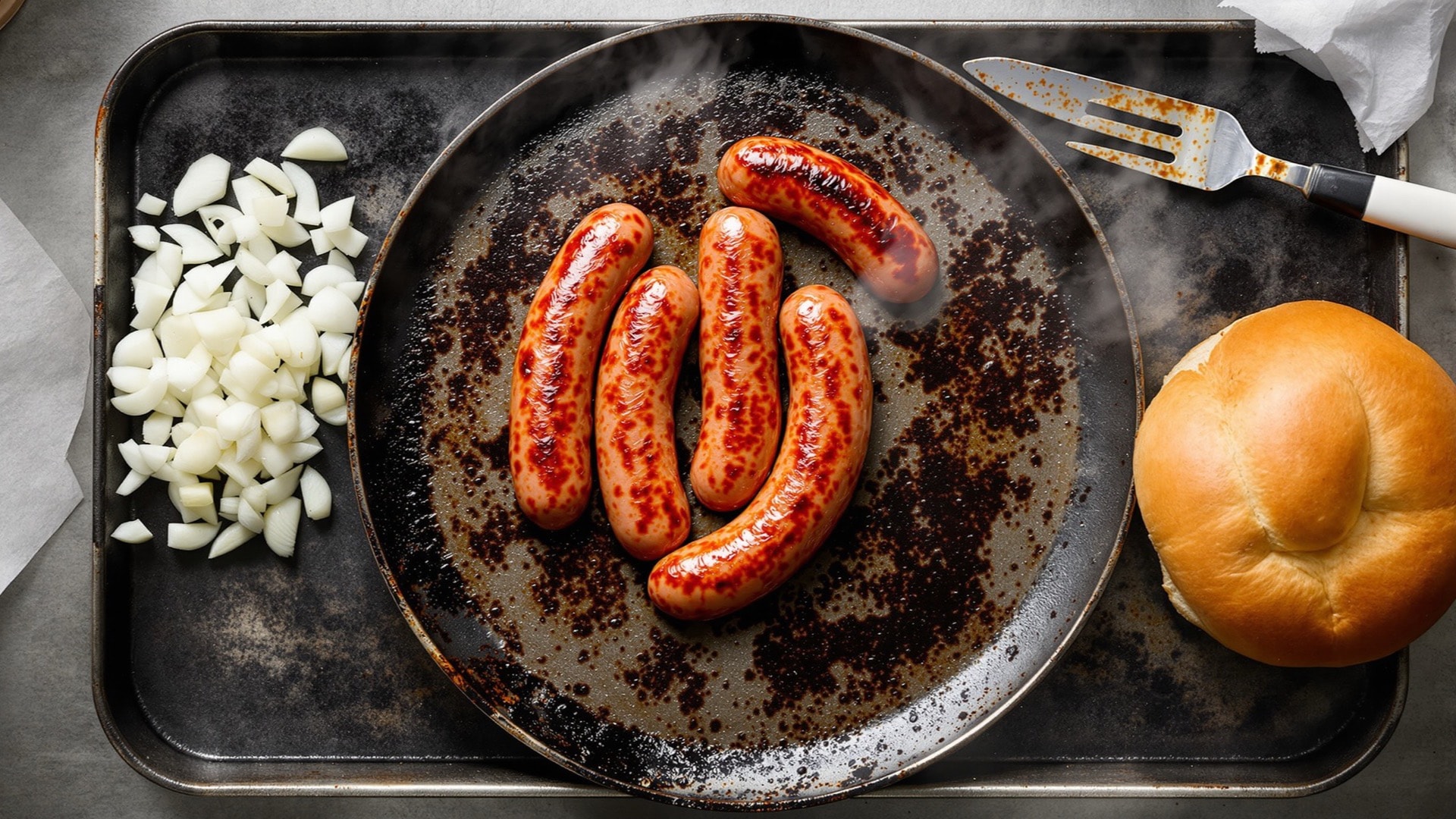
The half-smoke is the city's own sausage. It is coarse ground rather than emulsified, made from roughly half pork and half beef, seasoned with a moderate amount of red pepper, and smoked before it is ever sold. It is thicker than a hot dog and has a rougher texture, and because the smoking is done in advance, cooking it is a matter of finishing rather than of cooking through.
The standard treatment is to split it lengthwise and lay it face down on a flat griddle, so that the cut side caramelizes and the casing splits and curls. It goes into a soft roll and is usually dressed with chili, chopped raw onion and mustard, in that order, which is why it is eaten leaning forward.
What makes it local is the absence of a standard. The half-smoke was a product of local meat packers supplying local counters, and it never went through the national branding that flattened most American sausages into a single specification. It stayed a regional butcher's item, which is why one counter's version is noticeably coarser, smokier or hotter than the next.
Mumbo sauce
Mumbo sauce — also written mambo — is the red condiment that defines the carry-out counter. It is sweet first and tangy after, thinner than a barbecue sauce and glossier, built on tomato, vinegar and sugar with enough heat to register at the back. It is poured, not brushed: over fried chicken wings, over fried rice, over french fries, sometimes over all three in the same container.
The name is contested and the origin more so. A similarly named sauce has been sold in Chicago since the middle of the twentieth century, and which city produced it first has been argued in print and in trademark filings for years. The dispute troubles nobody standing at a counter here, because the Washington claim rests less on invention than on use: the sauce is not a garnish but part of how a specific meal is assembled.
The carry-out
That meal belongs to a building type. The carry-out is a small, family-run counter with no table service and often no seating, a menu board on the wall, a fryer, a griddle, long hours and a plexiglass screen. It is not a restaurant scaled down; it is a different institution, one that sells volume and speed to a residential block rather than an evening out to visitors.
Carry-outs also outlast the businesses around them, because their overheads are low and their trade is local. In neighborhoods that have turned over completely, the counter is frequently the one commercial address that has served the same food to the same street through the whole change — a useful thing to notice while reading our neighborhood guide.
Eastern Market and what a public market does
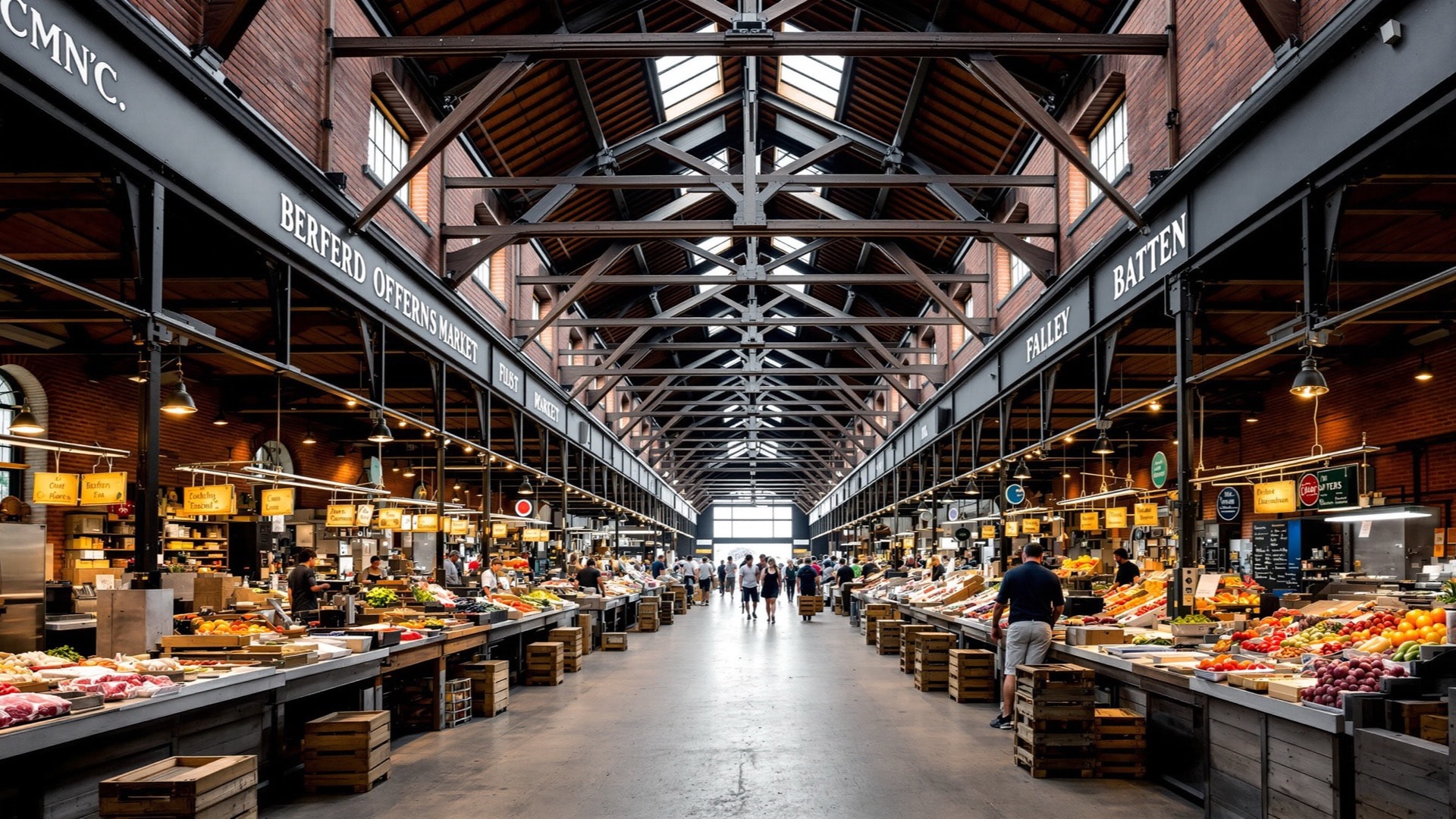
Eastern Market on Capitol Hill is a public market in the strict sense: the building is owned by the District government, not by a landlord or an operating company. It opened in 1873 as part of a nineteenth-century municipal system of market halls, and it is the last of that system still doing the work it was built for. A fire gutted it in 2007; the District rebuilt it and the tenants returned.
The difference between a market and a supermarket is worth stating plainly. In a market, the stalls are separate independent businesses, so a shopper deals with the butcher, the fishmonger, the baker and the produce seller as different people with different opinions, and the composition of the hall changes only when a tenancy does. Because the building is public property, that tenancy is a policy question and not simply a lease.
The rest follows from the layout. A hall with a public floor and no purchase requirement operates as a covered street: people cross it, meet in it and use it as a landmark, and on weekends its outdoor tables draw farmers and makers into the same trade. That is a civic function a store with one owner and one checkout line cannot perform.
The immigrant layers
The city's cooking has been reshaped repeatedly by arrival. Washington holds one of the largest Ethiopian and Eritrean populations outside the Horn of Africa, established through the political upheaval and war that followed 1974, and with it a full culinary vocabulary: injera, the fermented flatbread that serves as plate and utensil; long-cooked stews built on spiced butter and berbere; and a coffee ceremony that is a hosting ritual before it is a drink.
Salvadoran and other Central American communities, many arriving during the civil wars of the 1980s, brought pupusas, curtido and a distinct baking tradition to neighborhoods across the northern part of the city and the inner suburbs. Vietnamese resettlement after 1975 concentrated in the near Virginia suburbs rather than the District itself, which is why the region's pho, banh mi and herb-forward cooking are a short Metro ride out rather than a downtown affair — see reading the Metro map.
These are communities before they are cuisines, and their food arrived attached to churches, shops, remittances and language schools. Any account that treats them purely as a set of dishes has already missed the reason the dishes are here.
A civic institution with a fryer
Put together, the pattern is consistent: the food this city genuinely owns is the food that was never designed for export. It is assembled at counters, sold at low margins to people who live within walking distance, and passed along in the same way the music covered in our guide to go-go and the sound of Washington was passed along — by attendance rather than by distribution. The city's own neighborhood planning materials and the local history holdings of the D.C. Public Library are the practical places to trace how those blocks changed around the counters. The full guide index covers the rest.